
Job Can’t Be Saved
Quick Answer
A job can’t be saved when too much of the cost is already locked in and the contractor no longer has enough controllable variables to recover the remaining margin. Most jobs reach this point because labor overruns, missed change orders, and delayed cost tracking weren’t caught early enough. By the time the numbers are clear, the only option left is damage control—not recovery.

Contractor Pain Point
The job still looks active.
Crews are working. Billing is going out. Nothing feels like a disaster yet.
Then someone finally reviews the job closely—and realizes the margin is already gone.
Labor is blown. Materials are higher than expected. Extra work was done without pricing. Costs are still coming in. And there’s no realistic path back to the original profit.
This is the moment contractors face: the job can’t be saved.
And the worst part is this:
It didn’t just happen.
It built slowly through small misses that were never caught early enough.
Early in that process, most contractors already had warning signs—they just didn’t have a system to surface them clearly. A simple diagnostic like your Job Costing Health Report should have exposed the drift before it became unrecoverable.
Why This Happens in the First Place
Unsavable jobs are not caused by one bad decision.
They come from stacked breakdowns:
Weak or unclear job budgets
Poor job setup and inconsistent folders
Labor not tracked against production early
Vendor costs hitting late
Change work not priced in real time
No structured monthly job review
By the time the numbers are reviewed properly, the job is no longer flexible.
That is the real issue: loss of control, not just loss of profit.
This connects directly to earlier systems:
How a Job Becomes Unsalvageable
1. The budget was never strong enough to manage against
What to do:
Build a usable job budget with labor, material, equipment, and cost codes tied to real execution.
Why it matters:
You cannot correct a job if you never had a clear target.
What goes wrong if skipped:
The team operates without a benchmark, and overruns go unnoticed until it’s too late.
2. Labor overruns were discovered after the fact
What to do:
Track labor hours against production weekly.
Why it matters:
Labor is the fastest way to lose control of a job.
What goes wrong if skipped:
Once labor is spent, it is gone. Late discovery means no recovery.
See: How Early Job Setup Impacts Labor Performance (Before the First Hour Is Logged)
3. Change work was not priced fast enough
What to do:
Identify, price, and approve changes immediately.
Why it matters:
Unpriced work quietly destroys margin.
What goes wrong if skipped:
The job absorbs extra cost that should have been billed.
See: How Small Change Orders Destroy Construction Job Margins
4. Costs hit the job too late
What to do:
Keep invoices, receipts, and job costs current.
Why it matters:
Delayed cost visibility creates false confidence.
What goes wrong if skipped:
You think the job is fine—until all costs hit at once.
This is another point where a structured review like the Job Costing Health Report helps expose gaps mid-job.
5. Billing and WIP masked the real problem
What to do:
Regularly review percent complete, cost-to-complete, and billing position.
Why it matters:
Cash flow can hide poor job performance.
What goes wrong if skipped:
Jobs look healthy while profit is disappearing underneath.
See: WIP Accounting for Contractors Explained andWhy Construction Cash Flow Looks Strong While Jobs Lose Money
Controllable vs. Uncontrollable Costs (Where Jobs Actually Get Lost)
When a job starts failing, most contractors make a critical mistake:
They treat all costs the same.
They are not.
Controllable Costs (Still Fixable)
These are the only areas where you can still influence the outcome:
Remaining labor productivity
Crew size and scheduling
Equipment usage
Material handling and waste
Future subcontractor work
Why it matters:
These are your last levers to protect what margin is left.
If ignored:
The job continues to bleed even after problems are identified.
Uncontrollable Costs (Already Locked In)
These are already gone:
Labor hours already spent
Missed or underpriced change orders
Completed rework
Installed materials
Estimate gaps
Why it matters:
This defines your true job position.
If misunderstood:
Contractors delay reality and assume future performance will fix past losses—it won’t.
The Critical Shift
Once uncontrollable costs outweigh remaining margin:
The job is no longer recoverable.
At that point, the goal changes from:
Recovery → Containment
That means:
Tightening remaining labor
Stopping additional scope creep
Securing billing and collections
Documenting for closeout
The Physics of Margin Bleed: The Cost-Influence Curve
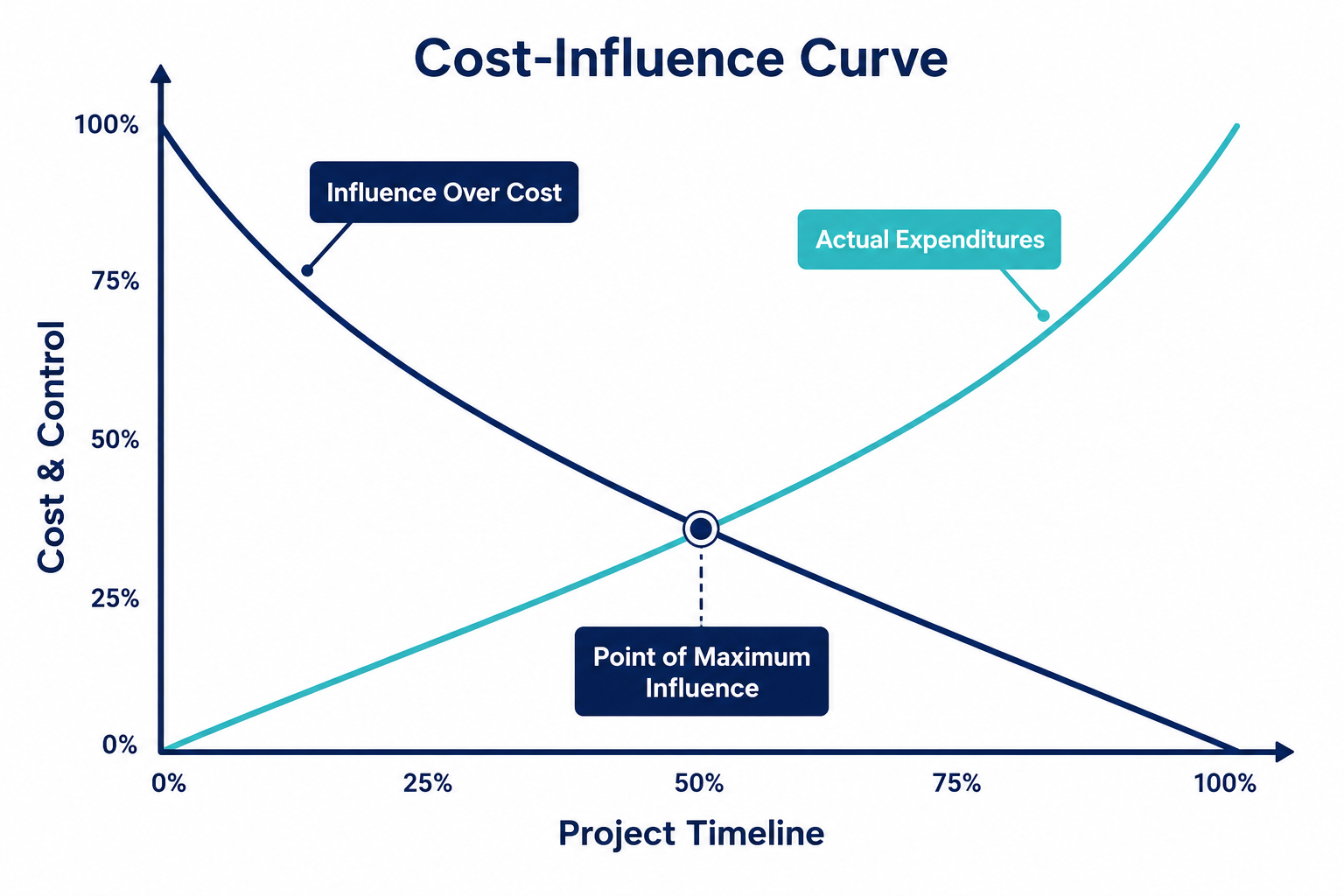
A project does not lose its margin evenly over time. Your ability to save a bleeding job drops exponentially as the project progresses. This concept is driven by the Cost-Influence Curve.
In the early stages of a project (the Planning and Rough-In phases), your influence over cost is incredibly high. If a labor overrun or material pricing spike is flagged at 10% completion, you have 90% of the project left to adjust your strategy—such as renegotiating supplier rates, changing crew sizes, or adjusting the field schedule.
However, as actual expenditures rise, your influence plummets. Once a project passes the 60% completion mark:
Most materials have already been ordered, delivered, and installed.
Your subcontractors have completed the majority of their contracted scope.
The direct labor hours have been spent.
At this intersection, your "controllable" costs shrink to a tiny fraction of the remaining budget. Even if your crew performs at 150% efficiency for the final trim phase, the math simply does not allow them to recover the losses incurred during the rough-in.
The Point of No Return: The Slippery Slope of "Cost to Complete"
To find out if your active project is already unsalvageable, you must calculate your Estimated Cost to Complete (CTC) weekly.
Use this diagnostic matrix during your weekly project review to determine if your project has crossed the point of no return:
Insider Notes / Contractor Gotchas
“We’ll make it up later” is the most expensive assumption in construction.
Other common patterns:
The estimate gets blamed when the real issue was execution control
Field teams see problems earlier than reports show them
Retainage and billing delay urgency
Cleanup accounting does not fix real losses
see: What Is Retainage in Construction? (How It Impacts Contractor Cash Flow)
The Key System: Tracking Jobs So This Doesn’t Happen Again
The goal is not just avoiding bad jobs.
It is catching them early enough to act.
1. Separate cost signals early
Track:
Labor vs budget
Materials vs budget
Change orders (pending vs approved)
Why it matters:
You see where the problem is—not just that it exists.
2. Track labor weekly
Why it matters:
Labor overruns become unrecoverable quickly.
3. Track change orders in real time
Why it matters:
Unpriced work compounds silently.
4. Keep cost posting current
Why it matters:
Delayed data hides real job performance.
Mid-process, this is where contractors should validate their system using the Job Costing Health Report.
5. Run a real monthly review
What to review:
Actual vs budget
Percent complete
Cost to finish
See: Monthly Close Checklist for Contractors (The Control System Most Shops Skip)
6. Set trigger points
Examples:
Labor exceeds budget by X%
Margin drops below threshold
Change orders exceed expected range
Why it matters:
Without triggers, problems get noticed—but not acted on.
Real-World Impact
Catching a job early allows adjustment.
Catching it late creates ripple effects:
Visibility
Numbers cannot be trusted.
Control
Field and office disconnect.
Profit
One job wipes out multiple winners.
And once that happens, the business is not just dealing with a bad job—it is dealing with unreliable systems.
Before that becomes a pattern, most contractors should step back and run a structured diagnostic like the Job Costing Health Report.
Summary Framing
A job cannot be saved long before anyone says it out loud.
It becomes unsalvageable when:
costs are locked in
visibility is delayed
and no one separates what can still be controlled
The solution is not better effort on bad jobs.
It is better systems that:
expose problems early
separate controllable vs uncontrollable costs
and force action before profit disappears
FAQ
1. How do I know when a job can’t be saved?
When remaining margin is smaller than known overruns and risks, and there are not enough controllable costs left to offset them.
2. Can better labor performance fix a bad job?
Only if caught early. Once most labor is already spent, improvement cannot recover past losses.
3. What is the biggest early warning sign?
Labor hours exceeding expected production without explanation.
4. Why do jobs look fine until they suddenly aren’t?
Because delayed costs, billing timing, and incomplete data hide real performance.
5. What should I do once a job is no longer recoverable?
Shift to containment: control remaining costs, secure billing, document everything, and identify system failures that caused it.
CTA
If jobs are becoming clear too late, the issue is not just project performance—it is system visibility. Tightening how labor, costs, and job data flow together is what prevents small misses from turning into unrecoverable losses



Disclaimer: This content is for general educational purposes only and does not constitute tax, legal, or accounting advice. Individual circumstances vary, and tax and reporting requirements can change. Always consult a qualified CPA, tax professional, or legal advisor for guidance specific to your business.
